
List of Material Topics
GRI: 3-1, 3-2
The identification of material topics is a necessary part of the process of preparing non-financial reporting in accordance with the GRI Standards. The purpose of this exercise is to study and identify the economic, environmental and social topics that are most important in terms of impact of the Agency’s activities on its stakeholders.
In 2023, the ESG Centre identified the material topics using a three-step procedure.
Step 1. Identification | Analysis of the Agency’s current position in ESG agenda Analysis of open information sources: industry trends and risks, research, media reports Consulting with the members of the ESG Centre Identification of current and potential impacts of the Agency’s activities |
Outcome | Preliminary list of material topics |
Step 2. Priority setting | Online survey of stakeholdersExpert RA defines its stakeholders as its employees and its customers (entities assigned all types of Expert RA ratings in accordance with approved methodologies), the members of its Board of Directors and senior management, including the members of its Management Board. The Agency posted a questionnaire on its corporate website and collected the feedback in Setting of priorities in the preliminary list of material topics, review of the online survey results |
Outcome | Adjusted list of material topics |
Step 3. Approval | Consideration and approval of the final list of material topics by the ESG Centre |
Outcome | Final list of material topics |
Material Topics
For the purposes of this Report, ten topics, with impact probability and impact strength assessed to be above 5.0, are regarded as material. Topics falling below the materiality threshold are examined with less scrutiny, although remain important to the Agency.
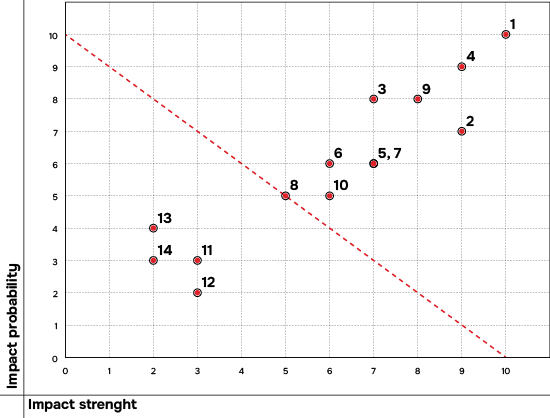
1 | Qualitative information about the issuance of independent ratings, assessments and opinions | 6 | Increasing public financial literacy |
2 | Promotion of the development of the responsible finance and ESG rating market | 7 | Assistance to small, medium-sized and large organisations in gaining access to funds |
3 | Personal data security | 8 | Assistance in market infrastructure development to facilitate the increase in individual and institutional investors |
4 | Decent work environment, skill development, staff retention | 9 | Promotion of equal opportunity and non-discrimination |
5 | Raising of the sustainable development awareness | 10 | Participation in special working groups, councils and regulatory initiatives |
11 | Responsible consumption (energy, material resources, office equipment) |
12 | Responsible waste management |
13 | The company’s participation in the implementation of initiatives that contribute to the development of local territories, including charity programmes |
14 | Procurement activities |
No | Topic | Affected stakeholders | Standards (GRI, SASB) |
|---|---|---|---|
1 | Qualitative information about the issuance of independent ratings, assessments and opinions | Customers, the government, investorsInvestors active in the Russian financial market. and other counterparties of the customers | GRI-203: Indirect Economic Impacts 2016 GRI 205: Anti-Corruption 2016 SV-PS-510a.1 |
2 | Promotion of the development of the responsible finance and ESG rating market | Customers, the government, investorsInvestors active in the Russian financial market. and financial market infrastructure participants, mass media | GRI-203: Indirect Economic Impacts 2016 |
3 | Personal data security | Customers, employees | GRI 418: Customer Privacy 2016 SV-PS-230a.1 SV-PS-230a.2 SV-PS-230a.3 |
4 | Decent work environment, skill development, staff retention | Employees | GRI 401: Employment 2016 GRI 402: Labor/Management Relations 2016 GRI 403: Occupational Health and Safety 2018 GRI 404: Training and Education 2016 SV-PS-330a.1 |
5 | Raising of the sustainable development awareness | InvestorsInvestors active in the Russian financial market., employees, the government, customers | GRI-203: Indirect Economic Impacts 2016 |
6 | Increasing public financial literacy | InvestorsInvestors active in the Russian financial market. | GRI-203: Indirect Economic Impacts 2016 |
7 | Assistance to small, medium-sized and large organisations in gaining access to funds | Customers, investorsInvestors active in the Russian financial market. | GRI-203: Indirect Economic Impacts 2016 |
8 | Assistance in market infrastructure development to facilitate the increase in individual and institutional investors | InvestorsInvestors active in the Russian financial market., financial market infrastructure participants | GRI-203: Indirect Economic Impacts 2016 |
9 | Promotion of equal opportunity and non-discrimination | Employees | GRI 405: Diversity and Equal Opportunity 2016 GRI 406: Non-discrimination 2016 GRI 408: Child Labor 2016 GRI 409: Forced or Compulsory Labor 2016 |
10 | Participation in special working groups, councils and regulatory initiatives | InvestorsInvestors active in the Russian financial market., financial market infrastructure participants | GRI-203: Indirect Economic Impacts 2016 |